
Heat Pumps
Heat pump - what the term means and how they work.
Heat pumps are widely touted as a partial solution to the domestic heat energy supply challenge, but without a wide general public understanding of the phrase, despite knowledge of what the individual words may mean.
The phrase is a metaphor for a process that inputs energy (mechanical power) to ‘move’, ‘lift’ or ‘pump’ heat between two ‘temperature levels’. The process is very important not only for domestic heat provision, but for many industrial and cryogenic processes.
There is often no actual pump in a heat pump cycle, but there is a compressor.
The ‘Heat pump’ is conceptually related to the term ‘Heat engine’ which takes energy from a high temperature heat source, generates power and outputs low temperature heat.
In simple terms, a ‘heat-pump’ is a ‘heat engine’ running backwards. To understand heat engines, we will look later at a fundamental thermodynamic power cycle elucidated about 200 years ago by Nicholas Leonard Sadi Carnot.
Basic process of a heat pump
In the form that is most familiar to the public, the heat pump takes in heat at a relatively low temperature (such as the ambient air) and by use of a compressor, circulating an appropriate fluid, delivers this heat PLUS the heat energy from the compressor at a higher temperature – such as required for domestic space heating.
Thus, the delivered heat energy is significantly more than the electrical energy drawn by the compressor’s motor driver. In this way domestic heating can be provided at a higher efficiency than a gas boiler or electric heating.
Considerations for domestic heat pumps
However, we must recognise three factors affecting heat pump perfromance:-
(i) When the ambient temperature is low, around or below freezing, the heat loss from a building is greater, and this must be compensated by the heat delivered by the heat pump.
(ii) Heat must be pumped from the low ambient up to above room temperature.
(iii) A temperature difference is required between the ambient (air or ground temperature) and the circulating heat pump fluid and also between the heat pump fluid inside the building and the desired room temperature,
Because of these, the heat pump compressor has to ‘work harder’ to deliver adequate heat at a comfortable room temperature, especially when the ambient or source temperature heat is low. Ground source heat is less influenced by variations in ambient temperature, but there is obviously a cost impact
A refrigerator is a heat pump
The same basic heat pump process ‘cycle’ is used for a vapour-compression refrigeration cycle where the prime objective is not to deliver heat but to absorb heat from the food in a refrigerator (i.e. to deliver ‘cold’) and to boost (‘pump’) it to a higher temperature and reject the heat via a coil at the back of the refrigerator.
Heat pumps are also used in different forms at a large scale in industrial and in cryogenic processes.
To dip into the origin of the process, we need to return to heat engines and look at the fundamental thermodynamic process elucidated some 200 years ago by Carnot. In fact, his enormous insight was to establish the fundamental limit in converting heat energy into work or mechanical energy in a heat engine - based upon the temperature level of the high temperature ‘heat source’ and that of the low temperature ‘heat sink’.
Referring to the diagram titled Carnot Power cycle below, the variable on the X axis, S is entropy. This is an important but rather abstract property of a fluid. When a quantity of heat, Q flows into or out from an amount of fluid, or a body, its entropy rises or reduces by an amount ΔS = Q / T, where T is the absolute temperature (Kelvins) at which the heat is received or removed. The vertical Y-xis shows temperature.
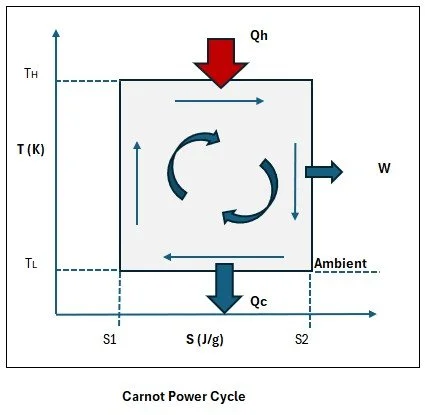
Heat Engine or Power cycle
When a pure liquid is boiled to produce a vapour, the more energetic vapour molecules have a higher entropy although their temperature is the same as the boiling liquid. This can be seen at the top of the Carnot cycle diagram where heat Qh is added at temperature TH increasing the entropy. After expansion and extraction of work (mechanical energy) W, the vapour is condensed at TL by removing heat Qc. The entropy reduction, ΔS= S2 – S1 = Qc/ TL. In the idealised Carnot cycle, the vertical steps take place at constant entropy.
Qualitatively, S reflects the degree of disorder or chaotic energetic movement of the molecules in the body or fluid. A high value of S is equivalent to a more chaotic state.
Heat engines of various types coupled with generators power most of the world’s electricity consumption and also power the means of transport on land, sea and air. Of course, part is now being replaced by electricity generated from wind and solar, but the majority comes still from heat engines of various types. Their efficiency can be objectively assessed by comparison with the ultimate benchmark, a perfect idealised Carnot cycle operating between the same two hot and cold temperatures.
Heat pump or Refrigeration cycle
This theoretical best possible engine (the eponymous Carnot cycle) can also be configured to operate in the reverse direction where power is input, and the circulating fluid absorbs heat at a low temperature and delivers it plus the mechanical work input, W to a higher temperature. This ‘reverse Carnot cycle’ is the ultimate benchmark when assessing heat pumps.
In the second diagram below which superficially looks about the same, it can be noted that the direction of the arrows is reversed. Now power or work, W is input and the heat is absorbed and pumped up from TL to TH where it is rejected from the cycle fluid, typically to ambient temperature.
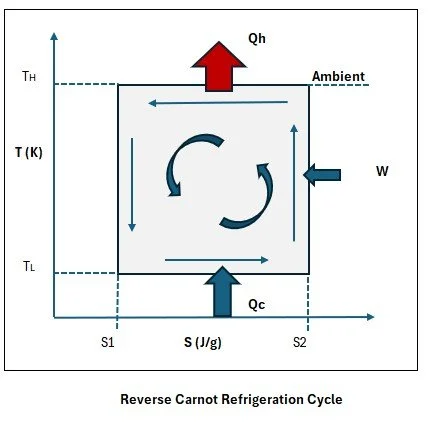
As well as efficiently providing space heating, the heat pump can supply refrigeration using essentially the same process. A dual role of heat pump for heating in the winter and air conditioning in the summer is feasible but somewhat more complex.
The rest of this article looks at the basic ‘vapour compression’ refrigeration cycle and its application as a heat pump to ‘drive’ a distillation process supplying both reboil heating and condenser cooling . A final section shows how the concept has been widened to include ‘internal’ heat pumps - common in the cryogenic sector.
The simplified PFD shows a compressor that absorbs work W (mechanical energy supplied by an electric motor) and discharges the HP cycle fluid to a cooler-condenser where the compressed vapour is condensed by removing heat Q-h. The liquid (refrigerant) is then reduced in pressure usually through a valve where a portion vapourises or flashes reducing the temperature to saturation at the lower pressure. The cold cycle fluid absorbs heat Q-c in a heat exchanger and vapourises in providing refrigeration before returning to the compressor suction.
The efficiency of the cycle can be compared against a reverse Carnot with the same values of Th and TL.
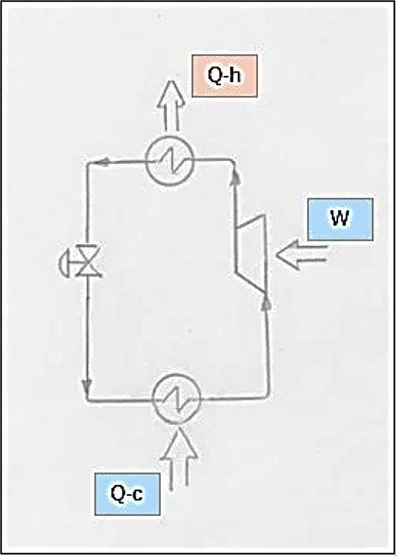
Single Stage Refrigeration cycle
Basic single stage vapour refrigeration cycle
The next PFD shows a simplified process in which a heat pump delivers heat to a column reboiler and in so doing condenses the cycle fluid. The fluid is then expanded and vapourised in the column overhead condenser to provide reflux.
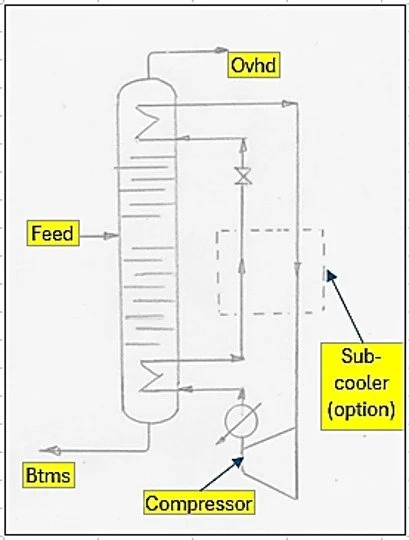
A heat pump providing column reboil and reflux
This application of the heat pump principle is most beneficial for separation of ‘close boiling’ mixtures where the temperature at the top and bottom of the column are close together. The relative volatility between the species being separated is low and so the column traffic and the reboil and reflux duties are large.
An example is the separation of propane and propylene which requires a tall column with many theoretical stages and high reflux and reboil rates. In these circumstances. The use of a heat pump is ideal because the heat has to be pumped through a very small temperature range which can be achieved with a relatively small amount of energy for the compressor.
Other examples include isotope separation, such as helium-3 from helium-4, a particularly challenging separation which requires consideration of the unusual properties of the two isotopes of helium and their mixtures.
Internal Heat pumps
We introduce this concept here, but it will be covered in more detail in a separate article.
In many cryogenic processes for liquefaction, a (vapour compression heat pump) refrigeration cycle is used for the inital cooling step. An example is LNG production at large scale where a propane refrigeration cycle is typically used for the initial cooling stage (from ambient to ca. -35C). In fact 2 or 3 cooling stages in series are typically used to reduce the power input required by the refrigeration compressor.
For cryogenic separation process, the heat pump has a different form and function. Here the stream delivering heat is a high pressure process stream, which may be a feed stream to the process available at high pressure or some stream internal to the process. Having delivered heat, for example to a reboiler, the condensed feed is then directed to a location in the process where it is reduced in pressure and hence temperature. The cold liquid or 2-phase stream may either be fed to a subsequent step in the process and/or used to refrigerate a column condenser.
Thus, there may be no heat pump compression cycle, but a high pressure stream - often a feed stream - that delivers heat and is condensed, then passes after expansion to where it is used as a cooling stream. The concept is used in a standard Air Separation processes, both in single column for nitrogen production, and the classic double column process for oxygen, nitrogen and argon production. The key point is that energy (in fact Exergy) is provided to the process by compression of the feed air.
For completeness, it should be mentioned that all cryogenic processes require refrigeration to offset heat ingress from the environment. To satisfy this in an ASU, a portion of the compressed air feed is, after cooling to low temperature ‘work expanded’ in a turbine. For refrigeration below a certain temperature (around -100 C) turbo-expansion is more efficient than vapour compression (heat pump) for providing the process’s refrigeration demand.
Related Articles